
Most organizations find out what AI says about them when a deal stalls and no one can explain why. The queries were running the whole time. The shortlist was forming. The company simply wasn’t in that conversation — or was in it as the wrong entity entirely.
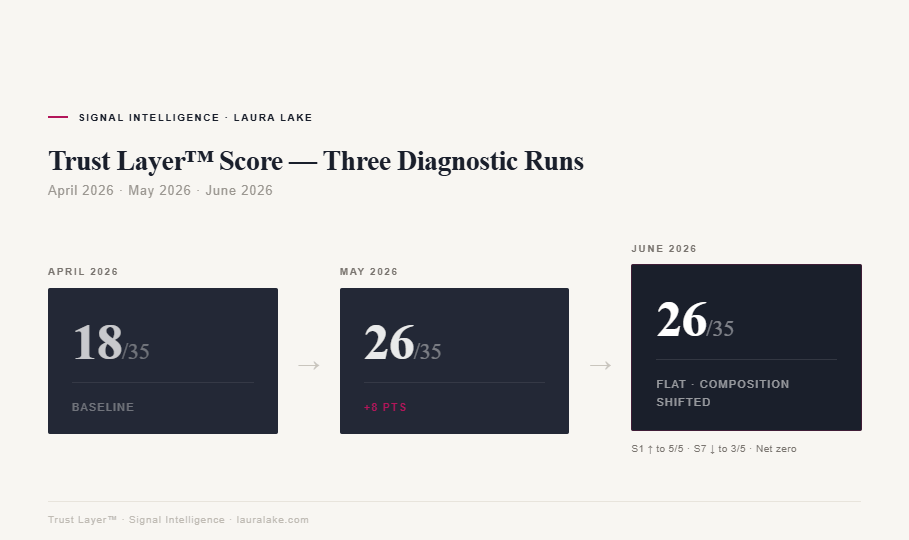
This is the third run of the AI visibility diagnostic on this research. The Trust Layer™ score held at 26/35 in June across five queries, four platforms, incognito mode, logged out. The April baseline was 18/35. The May retest documented 8 points of movement in 32 days and established two hypotheses: that the entity disambiguation problem on Claude would close within the Ninety-Day Reality Gap window, and that the Gemini category-ranking result from May would need external citation reinforcement to hold.
June tests both hypotheses. One confirmed. One corrected.
What the Five Diagnostic Queries Returned in June 2026
Query 1: “Who is Laura Lake?”
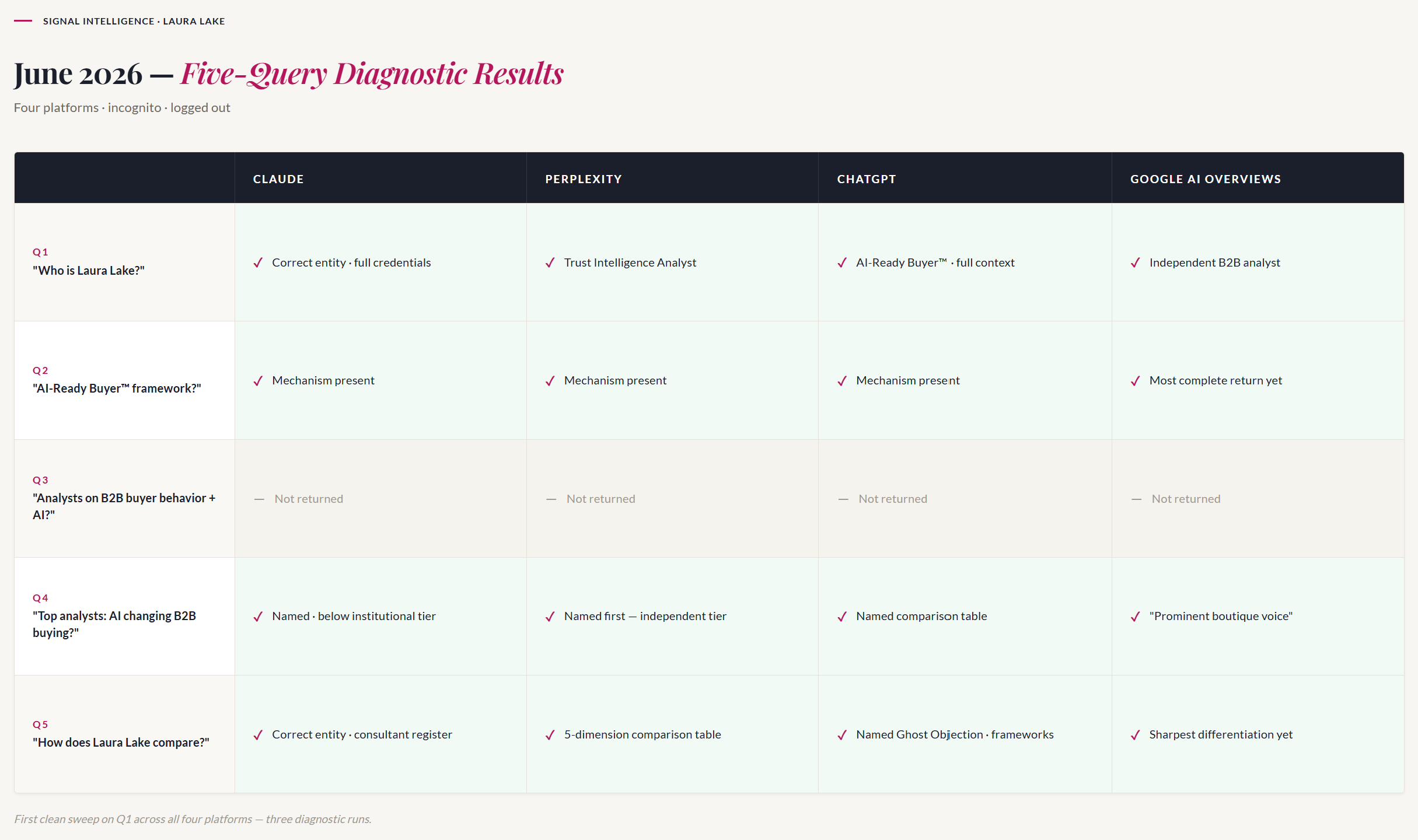
For the first time across three diagnostic runs, all four platforms resolve to the correct entity.
ChatGPT and Gemini returned correct results in May. Claude returned a British actress and stunt performer in both April and May — the entity disambiguation problem identified in April as the highest-priority signal architecture gap on a controlled surface. In June, Claude returns the correct profile with full credentials: the book, Consumer Behavior for Dummies , Signal Check™, 25+ years of B2B experience.
Perplexity returns “Trust Intelligence Analyst and founder of AI-Ready Buyer Research.” Google AI Overviews returns “independent B2B research analyst, strategist, and author.” ChatGPT returns the AI-Ready Buyer™ framework with full credential context.
Entity disambiguation on Claude closing is the most significant single movement in three months of testing. It is also confirmation that the Ninety-Day Reality Gap is operating as predicted: the April and May signal architecture corrections have propagated through Claude’s index on approximately the predicted timeline. The third-party source density that entity resolution requires came primarily from the book — the one asset in this architecture indexed independently of lauralake.com — and it appears by name in Claude’s June return.
Query 2: “What is the AI-Ready Buyer™ framework?”
The strongest Q2 return across all three diagnostic runs. Google AI Overviews returned the most complete framework description yet — naming the GEO Stack, the Seven Signal Surfaces , the 3 Signal Types (Consistency, Authority, Legibility), and the Five Markers. The GEO Stack reference is notable specifically: it is a named framework published separately, and its unprompted appearance in an AI Overview is evidence of cross-article coherence propagating through indexing — the vocabulary from one piece surfacing in AI synthesis of another.
Claude, ChatGPT, and Perplexity all returned mechanism-coherent descriptions: Signal Architecture™, Silent Committee™ , Trust Layer pillars, pre-contact vendor elimination logic. Framework indexing has reached ceiling across all four platforms. The vocabulary is landing. The mechanism is present, not just the terms.
Query 3: “What do analysts say about B2B buyer behavior and AI?”
No movement. Forrester, Gartner, IDC, 6sense, and G2 dominate all four platform returns. Google AI Overviews synthesized Forrester’s recent B2B AI-adoption survey data, Gartner’s rep-free buyer preference research, and 6sense’s findings on how much of the buying journey happens before vendor contact — without citing this research.
This query is the live readout of Peer Network Visibility (S4) and External Reference Footprint (S6). Both are scored below 4/5 in the current Trust Layer™ assessment. Appearing in category synthesis requires the kind of third-party citation density that those two surfaces measure. Q3 won’t move until they do.
Query 4: “Who are the top analysts studying how AI is changing B2B buying?”
Named on three of four platforms — the same count as May, but the positioning strengthened. ChatGPT returned a named comparison table placing this research alongside Forrester, Gartner, IDC, G2, and 6sense. Perplexity named Laura Lake first under “Independent / niche analysts” with specific framework attribution. Google AI Overviews described this research as “emerging as a prominent boutique voice focusing explicitly on Trust Intelligence and the precise web architectures required to influence LLM recommendations upstream.”
Claude named this research in the category but positioned it below the institutional tier — present, not yet competitive with Forrester and Gartner on that platform.
The May retest documented a Gemini result that placed this research first in the category query. That result was not retested in June — the June instrument replaced Gemini with Google AI Overviews, and the two platforms are not directly comparable. What the Ninety-Day Reality Gap predicts for third-party surface gains still applies: they are unstable until reinforced by external citations. The Q4 result that holds is the one that comes after byline placements accumulate — not before. May’s S7 score of 4/5 reflected that spike. June’s corrected score is 3/5, read on the platforms actually run.
Query 5: “How does Laura Lake compare to other analysts in this category?”
Three platforms returned structured, positively differentiated comparisons. ChatGPT named Ghost Objection, the Broken Funnel, the Silent Committee™, and Signal Architecture by name, framing this research as building “a distinct conceptual category around AI-mediated B2B buying before vendor contact.” Perplexity returned a five-dimension comparison table differentiating this research from IDC and Gartner on scope, conceptual frame, deliverables, and background. May’s most expensive finding — the wrong-entity contamination in this same Perplexity comparison — did not recur. The June return is clean. Google AI Overviews produced the sharpest differentiation language yet: where Gartner or Forrester tells a B2B company that buyers are migrating to AI search engines, this framework provides the tactical audit parameters to identify why an AI tool is recommending a competitor instead.
Claude returned the correct entity and accurate framework description, but resolved the positioning into a consultant/advisor register — “consulting-style diagnostic,” “consulting/speaking offering” — rather than analyst register. This is a register problem, not an entity problem. The entity is resolved. The category label is wrong on one platform. That is a different fix from what resolved Q1.
Trust Layer™ Score: June 2026 — 26/35
The June Trust Layer™ diagnostic returns 26/35 — flat from May. Composition shifted: S1 (Entity Clarity) closed a three-month gap on Claude and moved from 4/5 to 5/5. S7 (AI Category Ranking) corrected from 4/5 to 3/5. Net zero. The score held. The structure changed.
Note: The May article used “LinkedIn Signal” for S5. The canonical surface name on this site is Leadership Signal Layer. This corrects that label going forward.
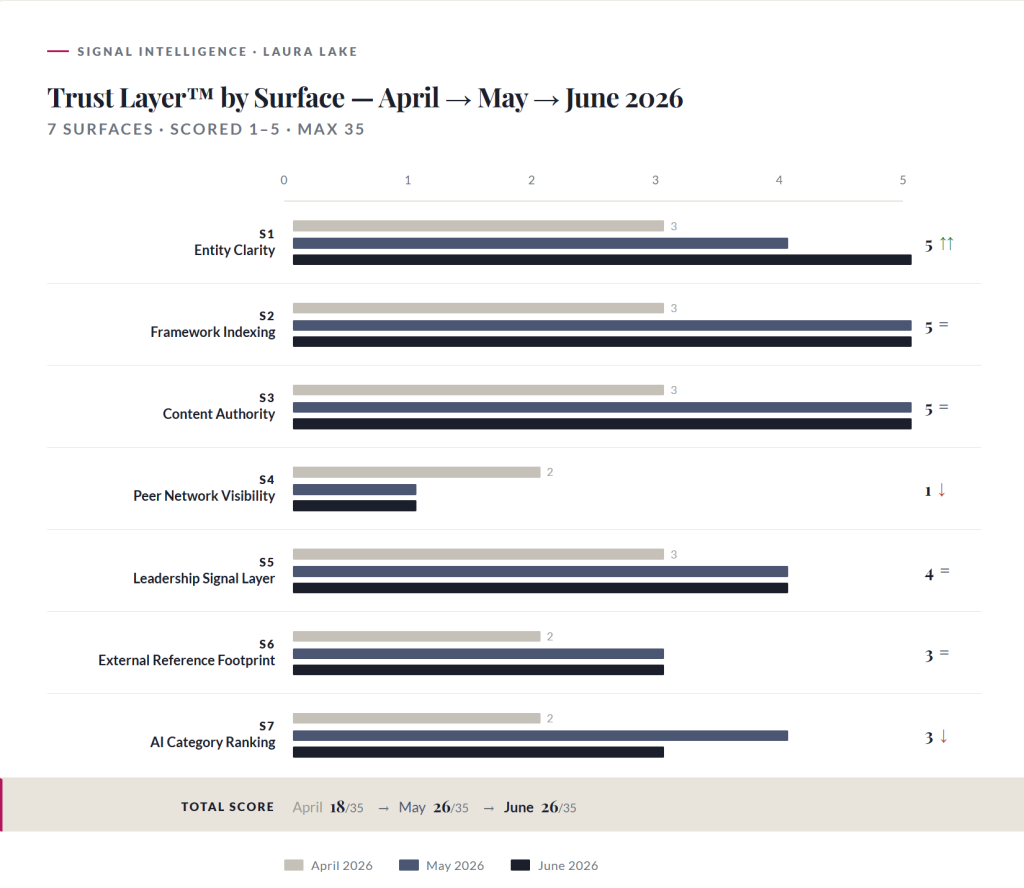
S1 — Entity Clarity: 5/5. The first 5 in this series on this surface. Claude resolving correctly is the diagnostic event of this run — three months of signal architecture work closing the gap that the April baseline identified as the highest-priority entity risk.
S2 — Framework Indexing: 5/5. Holds. Google AIO’s Q2 return — naming the GEO Stack alongside the Seven Signal Surfaces and the 3 Signal Types unprompted — is the most complete platform synthesis of this body of work to date.
S3 — Content Authority: 5/5. Holds at ceiling.
S4 — Peer Network Visibility: 1/5. No movement. The framework vocabulary has not escaped primary source orbit. Zero platforms reference these terms appearing in other practitioners’ language. This surface requires third-party action — practitioner amplification, peer citation, community uptake — that more owned content cannot produce.
S5 — Leadership Signal Layer: 4/5. Holds.
S6 — External Reference Footprint: 3/5. The book is indexing correctly across all platforms. No tier-1 bylines have landed yet. This surface moves when external citations accumulate — it is currently in a pre-accumulation state.
S7 — AI Category Ranking: 3/5. June tested four platforms: Claude, ChatGPT, Perplexity, and Google AI Overviews. This research was named in the category analyst query on three of the four. Google AI Overviews replaced Gemini in the June instrument; the two platforms are not directly comparable. May’s 4/5 was driven by a Gemini result. That specific result was not retested in June. The corrected reading of 3/5 reflects stable positioning on the platforms actually run: named and present, not yet competitive with institutional analyst firms at scale.
The Ownership Gap is operating on this research in exactly the form the framework describes. Surfaces 1, 2, 3, and 5 — the surfaces that respond to owned content and signal architecture — are at or near ceiling. The remaining gaps are not content gaps. They are validation gaps. Surfaces 4 and 6 — the surfaces that require other people to act — have not moved. That’s not a failure of the activation plan. It’s the structural condition the framework predicts.
What Does AI Say About Your Company? The Protocol Takes Forty-Five Minutes.
The five-query protocol is not proprietary. Five queries, four platforms, incognito mode, forty-five minutes. Three months of monthly data from this diagnostic provide a calibrated benchmark for what the results mean.
Step 1 — Entity query Query your company name directly. Note the exact noun AI uses to describe you on each platform. Not the sentence — the noun. Agency. Platform. Vendor. Consultant. Analyst. That noun is the category label AI has assigned based on whatever signals it found. If it doesn’t match the label you intend to own, the gap between those two things is your signal architecture problem made visible.
Step 2 — Framework query Query your methodology, framework, or named offering. Note whether AI describes it accurately — and whether the mechanism surfaces, not just the vocabulary. Terms indexing without mechanism coherence is a partial result. A buying committee running that query gets a label without an argument. That is enough to exclude a vendor from the shortlist without generating a visible objection.
Step 3 — Category query Run the category query — who are the top voices in your space. Note whether you appear on each platform independently. If you appear on one platform and not another, you have a platform-specific signal architecture problem. That requires a different fix than global absence. The shortlist forms from that query. Which platform a buyer happens to use determines who is on it.
Step 4 — Comparison query Run the comparison query last, on all four platforms. Whatever AI returns when it compares you to a category peer is the Ghost Objection risk profile the Silent Committee™ is working with. If the result is “insufficient data” — that is not neutral. If it returns the wrong entity — that is not a low score. That is the finding. The buying committee does not know the return is wrong. They work with what AI surfaces.
Step 5 — Read the platform split A single query on a single platform is not the finding. The pattern across four platforms is. A company that appears correctly on ChatGPT and incorrectly on Perplexity has a Perplexity-specific signal architecture problem that is invisible unless the diagnostic runs across all four.
The structural condition these queries surface is the default state for most organizations operating without a named owner for signal architecture. Marketing owns the website. PR owns earned media. Nobody owns what AI synthesizes from all of it — on each platform, independently, in real time. That’s the Ownership Gap. Reassigning a channel doesn’t close it. It moves the cursor.
The July Hypotheses
Signal architecture corrections take 30–90 days to propagate through AI indexing. The activation plan is a set of bets. The July retest is the measurement.
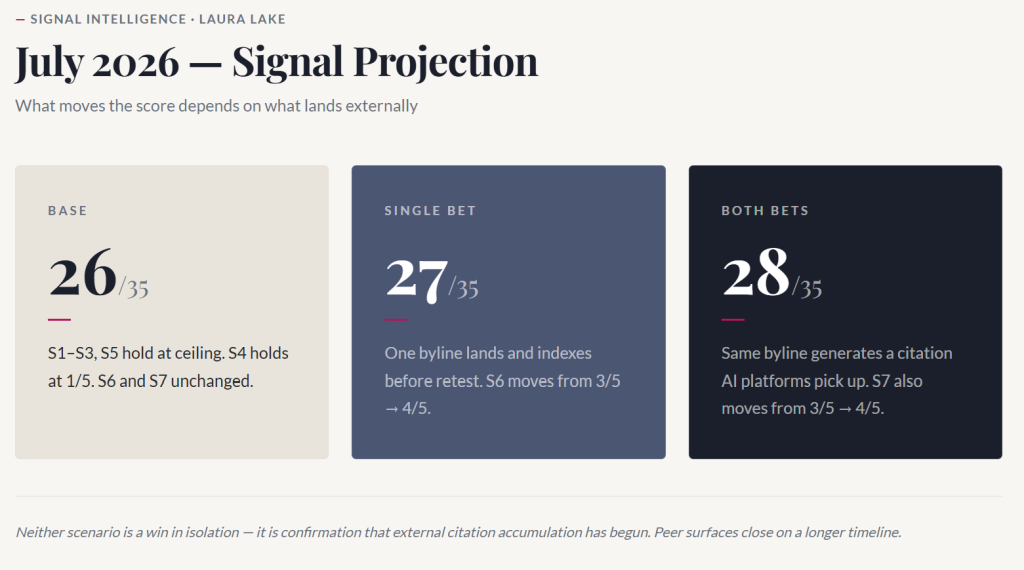
Base: 26/35. S1, S2, S3, S5 hold at ceiling. S4 holds at 1/5 — nothing is in motion that would move it before then. Single bet: if a byline in pitch stage lands and indexes before the July retest, S6 moves from 3/5 to 4/5 — score reaches 27/35. Both bets: if that same byline generates a citation AI platforms pick up, S7 moves from 3/5 to 4/5 as well — score reaches 28/35. Neither scenario changes the peer surfaces.
A score of 27/35 in July confirms the single bet landed. A score of 28/35 confirms both. Neither is a win in isolation — it is confirmation that the external citation accumulation phase has begun. The peer surfaces close on a longer timeline, through different levers.
Whatever AI says about your company today is your April baseline. It already exists — the queries return something whether anyone is reading them or not. The protocol above is how to read them. The July retest here will publish either way; the difference is whether you have your own number to read it against.
Frequently Asked Questions
What is the Trust Layer™ score for AI-Ready Buyer Research in June 2026?
26/35, flat from May 2026’s 26/35, and +8 points from the April 2026 baseline of 18/35. The diagnostic examines seven signal surfaces scored 1–5: Entity Clarity, Framework Indexing, Content Authority, Peer Network Visibility, Leadership Signal Layer, External Reference Footprint, and AI Category Ranking. Composition shifted within the flat score: Entity Clarity moved to 5/5 (first clean sweep); AI Category Ranking corrected to 3/5. Net: zero.
Which AI platforms correctly identify Laura Lake as a Trust Intelligence Analyst?
As of June 2026, all four platforms tested — Claude, ChatGPT, Perplexity, and Google AI Overviews — resolve correctly on the entity query. This is the first clean sweep across three diagnostic runs. In April and May, Claude returned a British actress and stunt performer.
Why did the AI Category Ranking score drop from 4/5 in May to 3/5 in June?
May’s 4/5 score was driven by a Gemini result. June tested Google AI Overviews in place of Gemini — the two platforms are not directly comparable. The June score of 3/5 is not a retest of the May Gemini result; it is a reading on a different instrument. On the four platforms actually run in June (Claude, ChatGPT, Perplexity, Google AI Overviews), this research was named and present on three of four — below the institutional tier of Forrester, Gartner, and IDC. That is the stable reading. Third-party surface gains are unstable until reinforced by external citations; the Ninety-Day Reality Gap predicts this behavior explicitly.
Why can AI identify a person but still exclude them from category results?
Name resolution and category inclusion are separate surfaces. AI can know who someone is and still lack enough category-level reinforcement to place that person in the shortlist. That is why Q1 can correct before S7 moves.
What is the difference between AI visibility and AI trust?
AI visibility means the entity appears. AI trust means the entity resolves correctly, carries the right noun, connects to the right category, and survives comparison. Visibility gets mentioned. Trust gets selected.
What is the Ownership Gap in AI signal architecture?
The Ownership Gap is the structural condition when no one owns the composite AI narrative across Marketing, PR, and Communications. Marketing owns the website. PR owns earned media. No one owns what AI synthesizes from all of it — on each platform, independently, in real time. Reassigning a channel doesn’t close it. It moves the cursor.
What is the Ninety-Day Reality Gap?
The Ninety-Day Reality Gap is the lag between a signal architecture correction and its propagation through AI indexing — typically 30–90 days from content publication to citation. Entity disambiguation is the slowest surface to move because it requires third-party source density, not just owned content.
What is a Ghost Objection?
A Ghost Objection is an objection formed through AI research before any sales conversation begins. The most dangerous form isn’t incomplete information about the right entity — it’s complete information about the wrong one. The buying committee doesn’t know the return is wrong. They work with what AI surfaces.
What does Peer Network Visibility measure and why is it stuck at 1/5?
Peer Network Visibility measures whether framework vocabulary appears in other practitioners’ language — third-party citations, community recommendations, peer amplification. It scores 1/5 because zero platforms reference these framework terms in any content other than lauralake.com. This surface requires external relationship-building, not more owned content. More published articles from this practice will not move it.
How often should companies run an AI visibility diagnostic?
Run the diagnostic monthly during active signal correction. Once the pattern stabilizes, run it quarterly. The point is not to chase every answer. The point is to see whether the pattern across entity, framework, category, and comparison queries is holding, fragmenting, or drifting by platform.
How does this diagnostic apply to my company?
The five-query protocol in the “The Protocol Takes Forty-Five Minutes” section above can be run on any organization. Five queries, four AI surfaces, incognito mode. The scoring layer uses Laura Lake’s Trust Layer™ rubric across seven signal surfaces.