
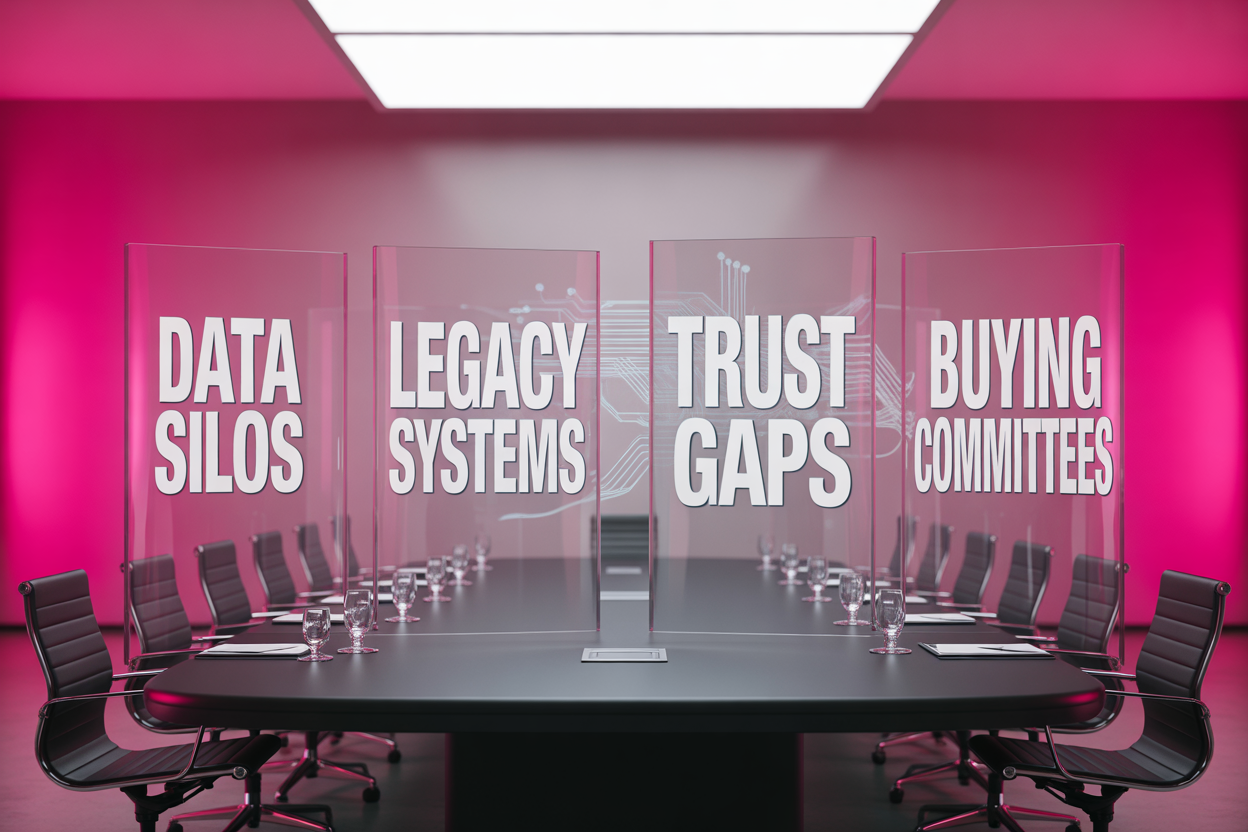
AI adoption in sales has a barrier problem. Just not the one most articles are solving for.
The four barriers everyone’s already written about
Data quality. Legacy systems. Rep resistance. Committee alignment.
Every AI adoption framework published in the last three years covers some version of these four. They’re real. The work to solve them is real work. Data silos do stall pilots. Legacy infrastructure does create integration drag. Sellers do resist tools they don’t trust. Committees do fragment when AI-generated insights aren’t framed for each role.
But every one of those barriers is internal. They describe what happens inside your organization as you try to get AI working for your sales team.
None of them describe what’s already happening outside it.
The barrier that formed while you were solving the others
While your organization was working through data governance and change management and rep adoption rates, buyers adopted AI too.
They didn’t wait for your rollout to complete.
They’re using AI tools right now to research your category, narrow a shortlist, and form a credibility judgment about your sales org — before your best rep sends a single email. Before your CRM registers a signal. Before anyone on your team knows an evaluation is happening.
The AI adoption barrier that’s actually costing you deals isn’t inside your organization. It’s in the gap between what buyers’ AI finds when it evaluates you — and what you’ve built for it to find.
That gap has a name: the Ownership Gap. Nobody owns how your company shows up in the decision infrastructure where buyers are actually forming their shortlist. The question bounces from sales to marketing to enablement and back. Everyone produces their piece. Nobody owns how the pieces connect.
And while it stays unowned, buyers’ AI is assembling an answer about you — whether you’re ready or not.
What buyers’ AI adoption actually changed about sales
The standard AI adoption in sales conversation focuses on what AI does for your team: sharper forecasting, faster research, better personalization, cleaner handoffs.
That’s half the picture.
The other half is what buyers’ AI does to your team’s effectiveness before the first touch.
A buyer’s AI copilot doesn’t evaluate your sales deck. It synthesizes your signal architecture — your content, your reviews, your proof, your consistency across every surface it can reach. It’s assembling an answer to the question your champion will eventually have to answer in a room you’re not in: “Why them?”
If your signal architecture can’t answer that question coherently, no amount of internal AI adoption fixes the problem. You can have the most AI-enabled sales team in your category and still not appear on the shortlist that formed before the funnel began.
The demand gen leader gets blamed for pipeline. The CRO calls it a late-stage conversion problem. The sales team runs another enablement cycle. Nobody asks what buyers found — or didn’t find — when they went looking before any of that started.
(That’s the pipeline review where everyone knows the number is wrong but nobody can name why. It happens in September. It shows up in November.)
What the Ownership Gap costs in practice
Most organizations have clear ownership for internal AI adoption: a sales ops lead, an enablement team, a RevOps function tracking tool utilization.
Nobody owns the external side.
Nobody owns what happens when a buyer’s AI tool evaluates your category at 10pm and your company either surfaces credibly or doesn’t. Nobody owns whether your thought leadership, your reviews, your case studies, and your leadership visibility are reinforcing the same answer — or pulling in different directions and reading as uncertainty.
When signals are fragmented, AI doesn’t interpret the inconsistency charitably. It synthesizes what’s there and returns a confidence rating. Low-confidence vendors don’t make shortlists. They don’t get a chance to overcome objections. The Ghost Objections — the credibility concerns that formed before any seller interaction — have already calcified by the time your rep is on the calendar.
The deal that looked healthy in the pipeline review disappears without a clean no.
Your AI adoption metrics look fine. Your win rate doesn’t explain it.
What closing the real barrier actually requires
Closing the Ownership Gap isn’t a sales ops problem. It isn’t a marketing problem. It sits at the intersection of both — which is exactly why it lands on nobody’s desk.
It requires someone who owns how the company shows up across the full decision infrastructure where buyers are forming judgment before any conversation begins. Not just the funnel stages that appear in the CRM. The upstream surfaces — content, reviews, schema, peer mentions, leadership visibility, proof alignment — that buyers’ AI reaches before your sales team is ever involved.
When someone owns that, the internal AI adoption work compounds. Sales enablement content reinforces the same signal buyers found independently. The rep’s first call confirms what the buyer’s copilot already suggested — rather than contradicting it. The champion can answer “why them?” without your help because the answer was already in the environment.
That’s what AI-ready sales actually means. Not a fully enabled sales team running better tools. A signal architecture coherent enough that buyers arrive already oriented — and your sales team closes what the environment already opened.
Frequently Asked Questions
What is AI adoption in sales?
AI adoption in sales refers to how sales organizations integrate AI tools into their workflows — forecasting, research, personalization, pipeline management. Most frameworks focus on internal adoption: getting reps to use the tools, overcoming data and legacy system barriers, aligning committees. The less-discussed dimension is external: how buyers have adopted AI to evaluate vendors before any sales conversation begins, and whether your organization has built a signal architecture coherent enough to surface credibly in that process.
What are the biggest barriers to AI adoption in sales?
The commonly cited barriers are data quality, legacy system integration, rep trust and resistance, and buying committee alignment. These are real and solvable. The barrier most frameworks miss is the Ownership Gap — nobody owns how the company shows up in the decision infrastructure buyers use before engaging sales. That gap costs deals before they ever enter the pipeline.
What is the Ownership Gap in sales AI adoption?
The Ownership Gap is the organizational space between what individual functions produce — content, reviews, sales decks, thought leadership — and what needs to happen for all of it to add up coherently in the places buyers evaluate before contacting your team. Sales owns the pipeline. Marketing owns content. Nobody owns how both connect in the upstream decision environment where buyers form shortlists. That’s the Ownership Gap.
How does signal architecture affect sales AI adoption?
Signal architecture governs whether your company’s outputs — across content, reviews, proof, leadership visibility — reinforce a coherent answer buyers can find and trust before any sales conversation. When signal architecture is fragmented, buyers’ AI tools return low-confidence results. That translates into deals that never form, shortlists you weren’t on, and Ghost Objections your sales team encounters without knowing where they originated. Internal AI adoption improvements don’t fix a signal architecture problem. They make you more efficient at a process that’s already starting too late.
What should sales leaders focus on beyond internal AI adoption?
Beyond optimizing internal tools and workflows, sales leaders should audit what buyers find when they evaluate the company independently — before any seller interaction. That means reviewing whether proof aligns with positioning, whether thought leadership builds a consistent case, whether reviews and peer mentions reinforce or undermine the sales message, and whether someone actually owns how all of it connects. The trust audit is the diagnostic for this.