

Buyers do not begin with outreach. They begin with trust conditions already forming inside the organization — a set of buyer trust signals assembled from sources the vendor never controlled and conversations the vendor never entered.
What looks from the outside like a response problem often formed earlier: a quiet internal shift, a familiar name surfacing at the right moment, an AI summary that holds up, a body of evidence sturdy enough to carry into rooms the vendor will never see.
What Starts the Process
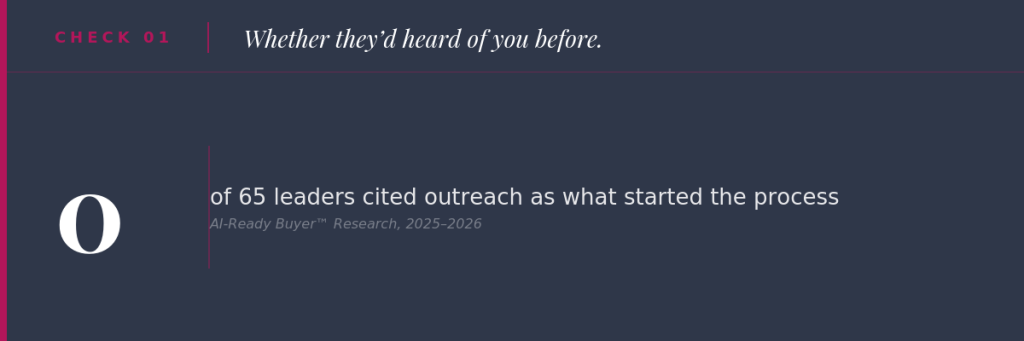
Analysis of interviews with sixty-five marketing leaders across the United States describing recent meaningful purchases in their own words pointed to the same pattern: the buying process started with an internal condition, not a vendor touch.
Zero cited an SDR outreach. Zero cited an email sequence. Zero cited a paid ad. The process began when something shifted inside the organization — a priority, a problem, a question one person put to another in a room.
That is why pipeline problems are misread. By the time a company notices that a deal did not materialize, the buyer has often been evaluating the category for weeks — running buyer trust signals against every vendor on their informal shortlist.
Signal Architecture and Why It Matters
Signal architecture is the structural design of the buyer trust signals buyers and AI systems use to form a verdict about your company before direct contact begins.
It includes what can be found, what can be cited, what appears consistent across the seven signal surfaces, and what holds up when someone tries to explain your company internally without help. When signal architecture is strong, each check a buyer runs reinforces the same picture. When it is fragmented, each check surfaces a different answer — and the verdict forms before anyone on the revenue team knows an evaluation is underway.
This is not a brand problem or a sales problem. It sits across every function and inside none of them.
The Four Buyer Trust Signals That Matter Before the First Conversation
1. Whether They Have Heard of You Before
Buyers do not start with a name they have never encountered. They respond to familiarity that has accumulated through low-pressure exposure over time: a peer mention, a prior article, a name that surfaces while researching an adjacent problem, a familiar result in an AI summary.
This is not awareness in the campaign sense. It is recognition density — the accumulated familiarity that makes a company feel known before it feels pitched. It is the first buyer trust signal, and it cannot be manufactured through outreach.
2. What AI Says About You
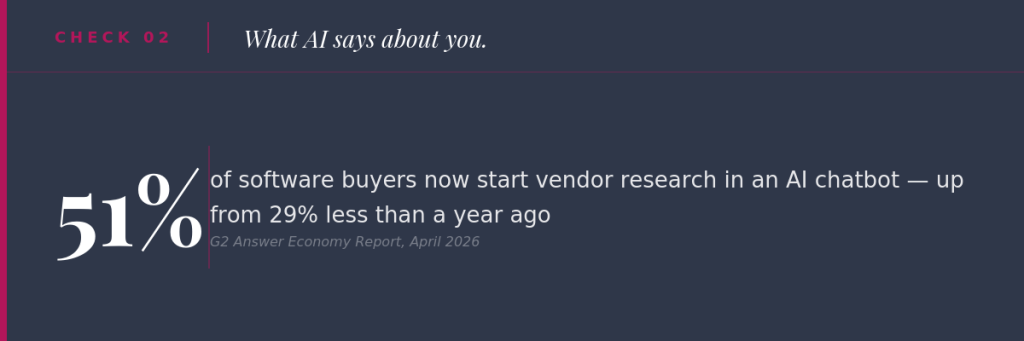
More buyers now begin AI vendor research before any sales signal appears. The shortlist can form before anyone downloads a report, fills out a form, or replies to a message.
That is only the first gate. Buyers use AI to narrow the field, then validate against independent sources: earned media, third-party commentary, editorial, reviews, and references. If the AI answer is thin or distorted, this buyer trust signal fails before a conversation has the chance to begin — and in some cases, the verdict forms as a ghost objection your team will never see.
3. Whether Your Earned Presence Holds Up
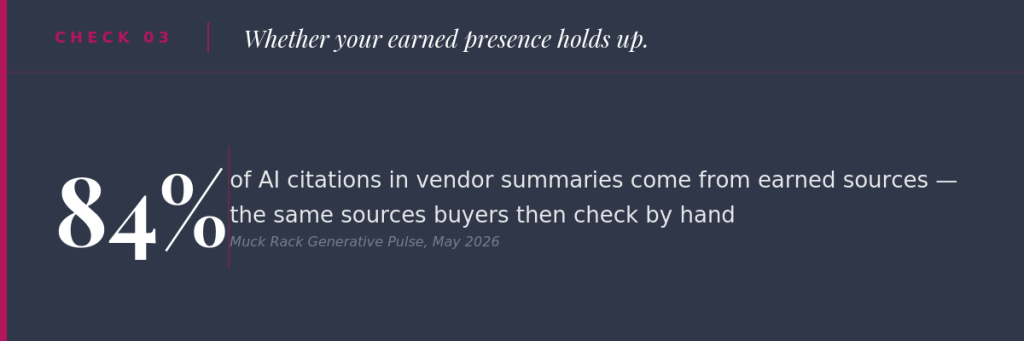
When buyers validate what they see, they lean on sources they do not control: third-party coverage, review environments, analyst language, editorial signals, and independent references.
If the earned layer is thin, two failures happen at once. AI citations have less to draw from, and the human buyer has less to carry into the internal conversation. The same thin earned layer that weakens the AI answer also weakens the buyer’s ability to build a case alone.
4. Whether Their Internal Case Will Hold
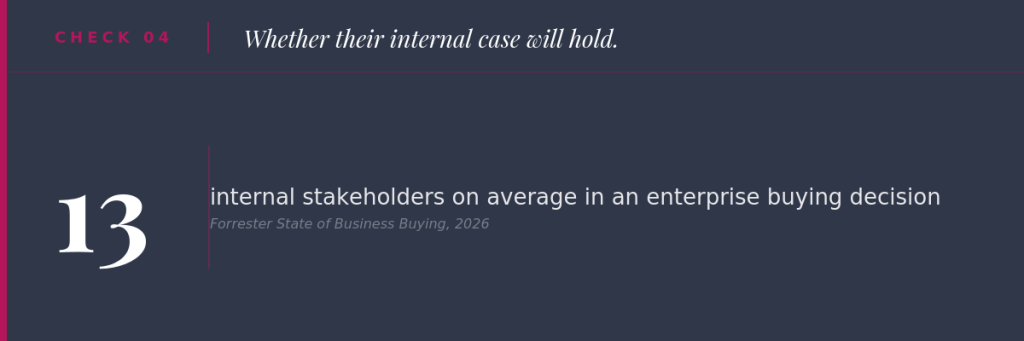
The buyer evaluating your company is not the only person who matters. Forrester research puts the average enterprise decision at thirteen internal stakeholders — and the buyer is already modeling whether they can carry your story into rooms they will be in without you.
The question is not only whether the product is compelling. It is whether the evidence is transferable. If the case is too hard to make alone, the deal disappears before it ever becomes visible to revenue teams. This is the buyer trust signal most vendors never think to build for — the internal transferability of their external evidence.
The Sequence Buyers Are Actually Running
Most go-to-market systems were designed for a different order: outreach, conversation, credibility, trust. Buyers reversed that sequence. Trust comes first. Conversation is what trust earns.
What appears downstream in the CRM is the aftermath of an upstream trust decision made in a room the vendor never entered. The buyer trust signals that determined that decision were assembled weeks before any sales motion fired.
The Ownership Gap
Inside most companies, someone owns the website. Someone owns earned media. Someone owns the demo. Someone owns nurture. No one owns the synthesis buyers actually evaluate before they respond — the signal architecture a buyer and an AI tool assemble, through the Silent Committee™, before a hand goes up.
That is the ownership gap. It sits across every function and inside none of them. Most companies find out it matters when the deals stop forming.
Frequently Asked Questions
What are buyer trust signals?
Buyer trust signals are the elements buyers evaluate about a vendor before agreeing to any direct conversation. They include organic name familiarity, what AI tools return about the vendor, the depth and recency of the vendor’s earned media presence, and whether there is enough external evidence for a buyer to build an internal case without help. None of these signals are triggered by outreach — all are built or not built before the first conversation begins.
What do buyers check before responding to a vendor?
Before responding to any outreach, buyers run four checks: whether they have heard of the vendor before through organic exposure, what AI tools say about the vendor, whether the vendor’s earned presence holds up under scrutiny, and whether there is enough external evidence to build an internal case without help from the vendor’s team. These are the four primary buyer trust signals that determine whether an evaluation moves forward.
What is signal architecture?
Signal architecture is the structural design of the buyer trust signals that buyers and AI systems use to form a verdict about a company before direct contact begins. It includes what can be found, what can be cited, what appears consistent across surfaces, and what holds up when someone tries to explain your company internally without assistance. When signal architecture is strong, each check a buyer runs reinforces the same picture. When it is fragmented, the verdict forms before anyone on your revenue team knows an evaluation is underway.
What is the ownership gap in enterprise buying?
The ownership gap is the structural problem inside most companies where no single function owns the composite picture buyers and AI tools assemble before a hand goes up. Someone owns the website. Someone owns earned media. Someone owns the demo. No one owns the synthesis — the buyer trust signals a buyer evaluates before they respond. Because it sits across every function, it belongs to none of them.
Why do pipeline problems look like response problems?
Pipeline problems look like response problems because the moment the problem becomes visible — no reply, no urgency, deal never forms — is not the moment the problem occurred. By the time a company notices that a deal did not materialize, the buyer has often been evaluating the category for weeks, running buyer trust signals against every vendor on their informal shortlist. The decision formed upstream, in a room the vendor never entered. What shows up in the CRM is the aftermath, not the cause.
How does AI affect the enterprise buying process?
AI tools are now involved earlier in the buying process than most vendors realize. Buyers use AI to build an initial shortlist before any sales signal fires — before a form is filled, a report is downloaded, or a message is replied to. Then they validate what AI returned against earned media and independent sources. This means there are two buyer trust signal gates vendors must pass: the AI answer and the human validation. Most vendors are optimizing for neither.
What is recognition density?
Recognition density is the accumulated familiarity that makes a company feel known before it feels pitched. It is the first buyer trust signal buyers run — and it does not come from outreach or advertising. It accrues through low-pressure exposure over time: peer mentions, articles that surface while a buyer is researching an adjacent problem, a name that registers as familiar when an AI summary returns it. Buying processes rarely start with a name the buyer has never encountered.