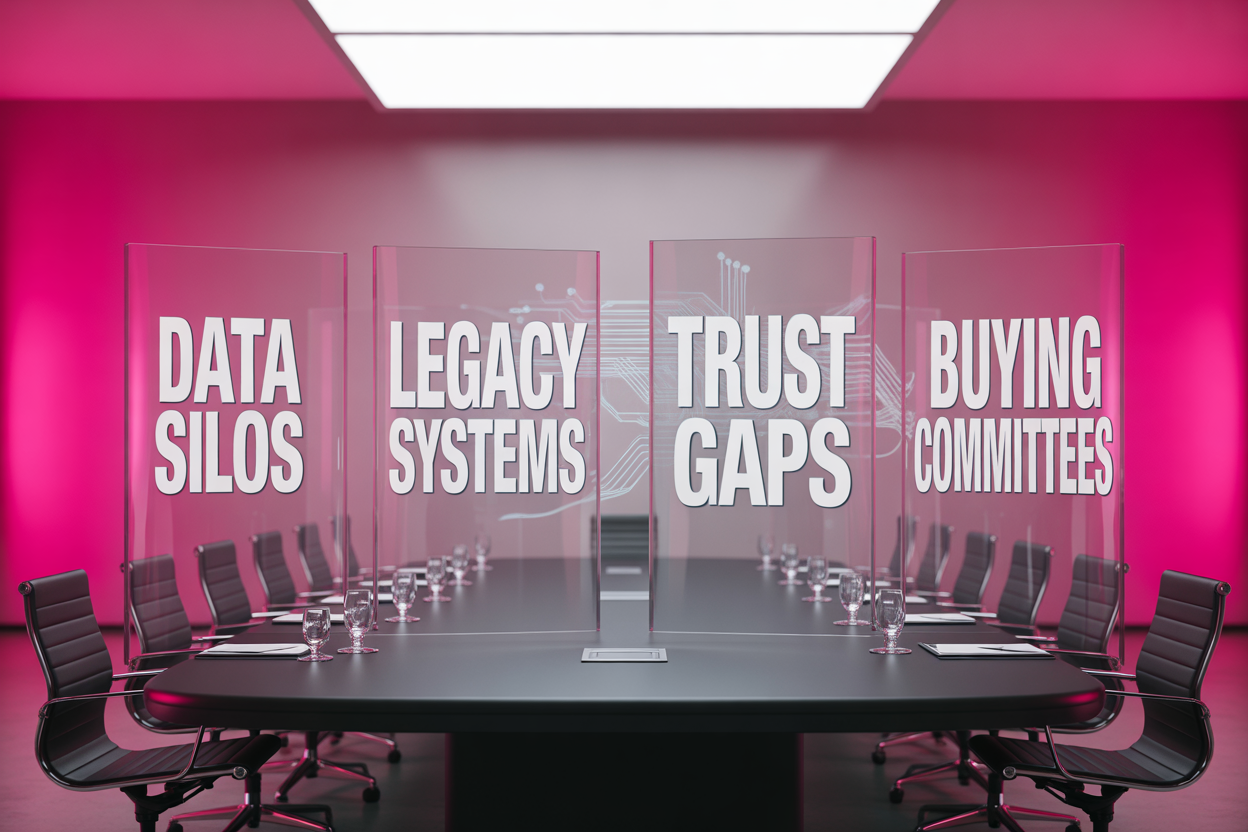
AI in B2B sales is no longer a buzzword. It’s boardroom reality.
Sales forecasting gets sharper. Workflows move faster. Buyer engagement feels personal. Win rates rise.
So why are so many teams still stalling?
Not because of the tech — but because of the humans, systems, and culture surrounding it.
The truth: AI adoption isn’t a technology challenge. It’s an organizational one.
Data silos. Legacy systems. Skeptical sellers. Divided buying groups. These barriers quietly erode momentum until even the best AI pilots flatline.
Leaders who win don’t race ahead with every shiny tool. They know adoption sticks only when they break through four predictable barriers.
Barrier 1: From Fragmented Data to Reliable Foundations
Every AI initiative starts with data — and that’s where most stumble.
Sales orgs run on fractured ecosystems: CRM records here, marketing automation there, spreadsheets on shared drives, and seller notes never logged at all. Garbage in, garbage out. When insights feel unreliable, sellers stop listening.
📊 72% of sales leaders cite data quality as their number one barrier to AI success (Salesforce, 2024). That’s nearly 3 out of 4 leaders stuck before they even take off.
The breakthrough? Start small.
- Map only your most critical data sources
- Standardize core definitions like “qualified lead”
- Pilot AI on one clean dataset (e.g., opportunity close rates)
This focused approach builds early trust — and creates a runway for growth.
Barrier 2: Wrestling with Legacy Systems
Reliable data won’t help if your infrastructure can’t keep up.
CRM and ERP platforms built decades ago weren’t designed for real-time AI. Bolting on integrations often leads to delays, ballooning costs, and IT pushback.
Leaders who break through don’t fight the whole system at once. They:
- Start at the edges (territory planning, lead enrichment, forecasting)
- Choose API-driven tools over heavy customizations
- Deliver visible quick wins like automated call notes or AI-driven account research
These small wins compound. Sellers adopt because life gets easier. IT supports because risk stays low.
Barrier 3: Building the Trust That Sustains Adoption
AI adoption isn’t just technical. It reshapes roles.
- Sellers worry about losing control.
- Buyers question accuracy.
- Executives fear reputational risk.
Research from BCG is blunt: more than half of AI projects fail due to lack of trust — not lack of capability.
Trust grows when leaders:
- Explain how models reach recommendations
- Clarify where human judgment stays essential
- Frame AI as augmentation, not replacement
The shift is simple but powerful: AI stops being a black box and starts being a partner. Sellers keep autonomy, buyers see transparency, and adoption sticks.
Barrier 4: Aligning Committees, Not Dividing Them
B2B buying rarely rests on one decision-maker. Gartner shows six to ten stakeholders shape the average deal — each with different priorities.
Poorly framed AI insights can create more division, not less.
Leaders who get it right use AI to decode committee dynamics:
- Mapping sentiment across the group
- Surfacing hidden influencers
- Tailoring insights to each role (CFO = risk and ROI, Ops = efficiency, Sales Exec = pipeline health)
Done right, AI becomes the neutral ground — a shared fact base that unites instead of fragments.
The Human Layer of AI Adoption
Look closely at these barriers and you’ll see the same pattern: they look technical, but they’re really human.
People adopt what they understand.
They trust what feels consistent.
They embrace what makes them better.
Organizations that weave these principles into their strategy don’t just roll out new tools. They build belief in a new way of working.
Lessons from the Field
- SuperAGI: A SaaS startup integrated AI-powered CRM enrichment and lead scoring, tripling revenue and boosting conversions 30% in six months.
- Prudential + Microsoft Dynamics Copilot: Deal velocity up 40%. Sales costs down 25%.
- EY + European Telecom: A 50% lift in AI-driven lead conversions — achieved by emphasizing transparent human-AI collaboration.
ZoomInfo’s 2025 survey makes the divide clear: 80% of non-users worry about accuracy. Successful adopters point to unified data and human interpretation as the keys to success.
The Culture Multiplier
Technology can spark adoption. Culture makes it stick.
Winning organizations:
- Train sellers to work confidently with AI
- Hold leaders accountable for embedding adoption in goals
- Celebrate quick wins to build momentum
- Reward experimentation so early adopters become champions
This cultural multiplier turns pilots into lasting impact. The result? Stronger adoption, happier teams, measurable growth.
💡 Executive Takeaway
AI adoption in B2B sales doesn’t fail because of algorithms. It fails because of human barriers.
Leaders who win focus on:
➤ Building reliable data foundations
➤ Modernizing without heavy legacy drag
➤ Embedding transparency to foster trust
➤ Using AI to unify — not divide — buying committees
📈 The payoff: faster cycles, higher conversions, and a culture where AI amplifies human expertise instead of replacing it.
The Bottom Line: Human Trust Turns AI into Advantage
The companies that win won’t be the ones who adopt AI the fastest. They’ll be the ones who embed it the wisest — aligning technology with trust, culture, and human decision-making.
The future of B2B sales won’t be defined by algorithms alone. It will be shaped by leaders who know how to unite humans and AI in one fabric of decision-making.
👉 Ready to help your team overcome these barriers? Download the AI-Ready Buyer™ Briefing for the four shifts shaping today’s buying committees — and the strategies leaders use to stay ahead.