

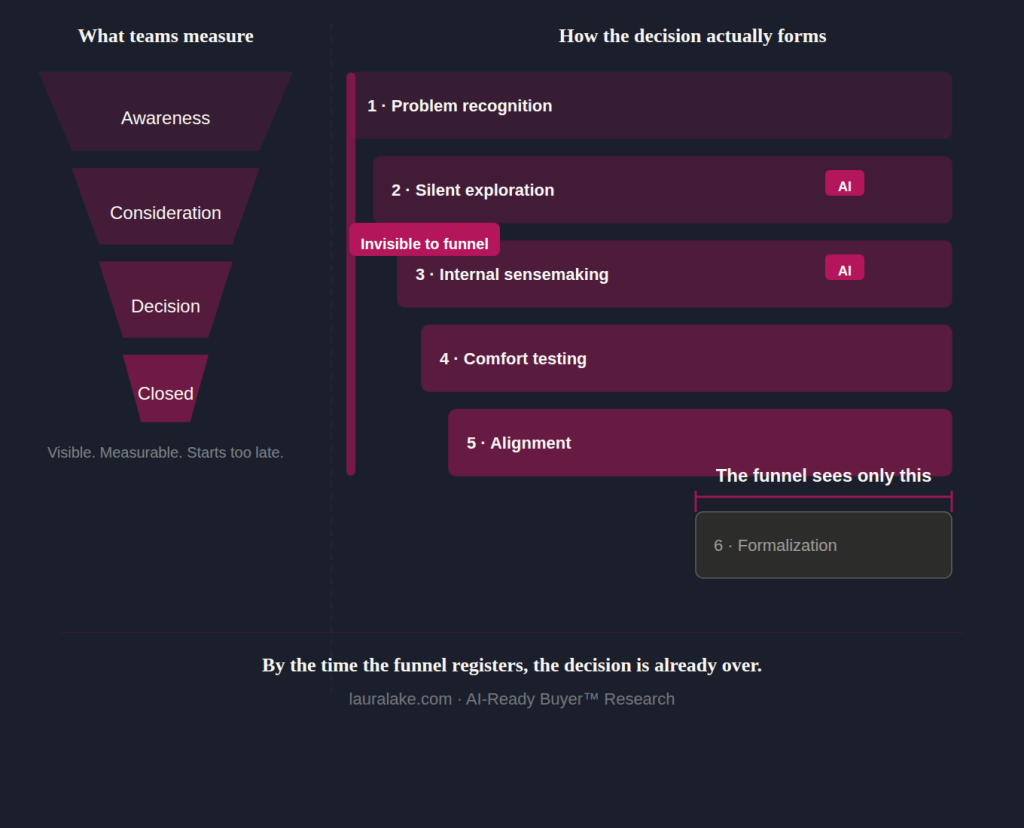
The buying decision process now unfolds long before most teams realize a decision is being made. Most B2B decisions don’t behave like a funnel anymore. But most teams are still measuring them like one — and paying for that lag without realizing it.
AI-led research, anonymous exploration, and expanding buying committees mean that internal comfort around a decision is usually formed—or lost—long before a formal “opportunity” exists. By the time a deal shows up in a dashboard, much of its outcome is already socially settled.
This reframes the buying journey not as a sequence of stages, but as a sequence of conditions:
- private problem recognition
- silent exploration
- internal sensemaking
- comfort testing
- alignment without announcement
- formalization
Most go-to-market strategies are still optimized for the visible tail end of a process that has already decided its direction. The real leverage now lies in creating proofs, narratives, and signals that can travel inside the organization—through AI tools, Slack threads, and internal decks—without you in the room.
How the Buying Decision Process Actually Forms
Modern B2B buying didn’t get messier. It got redistributed.
What used to be visible, vendor-led stages are now scattered across private research, peer conversations, and internal interpretation—almost all of it happening outside traditional funnel visibility. The models many teams still rely on were built for a world where sellers controlled information and sequence. That world is gone, even if the dashboard hasn’t caught up.
Deals now move—or stall—based less on where a buyer sits in a journey and more on whether the people involved feel safe enough, together, to let the decision stand.
What follows is not a linear path. It’s a set of overlapping conditions that determine whether comfort compounds quietly—or erodes without confrontation.
Condition 1: Problem Recognition
(Private, Not Declared)
Buying rarely begins with a formal initiative. It begins with private unease.
Someone notices friction, exposure, or risk—often triggered by a near-miss, an audit finding, a competitor move, or a pattern in the data that makes one thing clear: we’re not as safe as we think we are.
Because AI tools let people look things up quietly, concerns can be tested without being exposed. Individuals can validate the signal, scan peer content, and run comparisons without opening a ticket, calling a meeting, or asking for budget.
The buying process starts before the organization admits it is buying. By the time it does, the options have already narrowed.
Condition 2: Silent Exploration
(AI-Led, Socially Safe)
Once unease hardens into this might need fixing, exploration begins—but not in ways most teams ever see.
It shows up as late-night AI prompts, bookmarked benchmarks, private Slack threads, and zero-click answers that surface vendors without creating a visible trail. This work is asynchronous, distributed, and deliberately low-risk.
People want options without attention. So they lean on AI, review aggregators, and private communities to understand the landscape without alerting leadership, procurement, or finance.
Evaluation now happens before alignment.
Condition 3: Internal Sensemaking
(Meaning Forms Without Vendors)
This is where most decisions quietly finalize — inside what the AI-Ready Buyer™ framework calls the Silent Committee™: the group of internal stakeholders who evaluate, interpret, and effectively decide vendor fit without seller presence.
Exploration produces artifacts: AI summaries, shared documents, screenshots, comparison tables, pricing fragments, and peer anecdotes.
Those artifacts circulate internally, stripped of original framing and reinterpreted through the organization’s history, politics, and scar tissue. This is interpretation drift in motion: the same content means something different by the third retelling, shaped by whoever passed it along and whatever agenda was already in the room.
This is where it stops being easy to change people’s minds.
This is where it stops being easy to change people’s minds.
Risks are named informally. Early verdicts—this would never survive here or this might finally fix X—form long before a demo. Champions test your story socially: Would legal block this? Could IT support it? Would this make us look careless?
Vendors are usually absent. Your message is compressed, reassembled, and judged for social survivability inside rooms you never enter.
The buyer’s story about you forms before you ever speak.
After this point, disagreement becomes personal instead of hypothetical.
Condition 4: Comfort Testing
If a solution survives sensemaking, the organization moves into comfort testing. On the surface, this resembles evaluation—security reviews, pilots, reference calls.
Underneath, something else is happening.
- Who absorbs the downside?
- Who is exposed if this fails?
- Whose credibility is on the line six months from now?
Every department maps the decision to its own risk lens. Proof functions less as evidence of capability and more as future cover—whether people feel they can stand behind the decision later without regret.
These risk assessments rarely surface as explicit objections. They become Ghost Objections — credibility concerns that form privately, travel through the organization without being voiced, and determine the outcome before any vendor knows they existed. At that point, no one says no — they just stop backing it.
Condition 5: Alignment Without Announcement
When comfort compounds, alignment forms without ceremony.
Meetings turn procedural. Objections soften. People stop arguing if the decision is right and start negotiating how to make it work. No announcement is required.
When comfort doesn’t compound, urgency drains without drama. The deal slips into “next quarter.” On paper, it remains open. In reality, no one is willing to spend political capital to push it through.
Decisions resolve themselves before anyone names them. What looks like “no decision” is often a quiet decision to protect careers instead of changing course.
Condition 6: Formalization
(Documentation, Not Persuasion)
Formalization is where most GTM dashboards finally light up. By then, influence is minimal.
Procurement, legal, and finance document a direction the group has already chosen. They may adjust terms or timelines, but they rarely reverse a decision that feels socially settled unless a new, material risk appears.
Final approval is administrative.
By the time a deal reaches this point, the decision has already ended.
That’s why deals rarely end with a clear no anymore — they stay in the system even after people stop responding.
The Strategic Implication
Funnels instrument the last step of a process that has already done its real work.
In environments shaped by AI and large buying groups, the question isn’t how to move leads through stages. It’s whether your proof and narrative can survive without you present.
The work now is creating messages that still make sense when you’re not there to explain them.
That means signals that are:
- legible to AI
- quotable in Slack
- survivable in committee
If what you publish can’t be summarized by an LLM, copied into an internal thread, or defended by a non-expert in a tense conversation, it won’t shape the outcome.
The new B2B buying process isn’t about mapping more stages.
It’s about noticing how early comfort forms—and how rarely those early conditions are revisited.
Why the funnel misreads how decisions form
Most teams still rely on funnels to explain buying behavior because that’s what dashboards can see.
Funnels track when activity becomes visible — meetings, stages, approvals. But they don’t show when decisions actually start forming.
That gap is why so many deals feel “real” long after the decision has quietly settled. The issue isn’t execution. It’s what the model is trained to notice.
| What the funnel assumes | What’s happening instead |
|---|---|
| Decisions move through linear stages. | Decisions form through overlapping conditions. |
| Buying activity is visible throughout the process. | Most decision-making is invisible early and only surfaces late. |
| Progress is driven by buyers moving forward. | Progress depends on whether people feel comfortable backing the decision. |
| AI shows up during formal evaluation. | AI shapes early research, comparison, and internal interpretation. |
| Decisions happen near approval. | Decisions settle during internal sensemaking. |
| Alignment is explicit and declared. | Alignment forms quietly without announcement. |
| Approval is the decision moment. | Approval documents a decision that’s already over. |
| Dashboards reflect buying reality. | Dashboards mostly show the aftermath. |
This article is a companion to Broken B2B Funnel. Together they make one argument: the buying decision process changed, and the funnel never caught up.
That first piece covers the external journey — the dark funnel, AI-led discovery, and the offstage loops where intent now forms. This one goes inside the account. It maps the internal conditions where the buying decision process actually settles: how unease appears, how comfort forms or collapses, and why most of the outcome is locked in long before a stage changes in your CRM.
Read them together. The funnel is broken. This is the map that replaces it.
FAQs
What is the B2B buying decision process today?
The B2B buying decision process now happens long before most teams realize a decision is being made. People research quietly, test ideas internally, and form opinions before anything shows up in a funnel, dashboard, or formal buying stage.
Why do B2B deals feel decided before sales gets involved?
Because most B2B decisions are shaped through internal conversations, private research, and risk discussions that happen without vendors present. By the time sales is engaged, the group has often already settled on what feels acceptable.
Why do so many B2B deals stall instead of closing or ending?
Many deals don’t end with a clear no. They stay open in systems even after people stop responding, meetings stop happening, and internal support fades. No one formally closes them out because the decision was never announced—it just quietly resolved.
How does AI affect the B2B buying decision process?
AI allows people to explore concerns, compare options, and pressure-test ideas privately. This reduces the need to ask questions publicly and speeds up internal decision-making before any formal buying process begins.
What matters most in influencing B2B buying decisions now?
What matters is whether your message still makes sense when you’re not there to explain it. Decisions form through repetition, interpretation, and internal retelling—often without vendor input.
Is the B2B buying decision process still a funnel?
Not really. While funnels still describe reporting stages, they no longer reflect how decisions actually form. Most of the important work happens before anything moves forward formally.