
When B2B buying committees evaluate vendors, trust questions get answered in side conversations long before formal evaluation begins. Here’s the framework they’re using—and what it means for your sales and marketing strategy.
B2B vendor trust questions determine which companies make the shortlist before the RFP gets issued. Most complex B2B vendor selection decisions are already decided before your first meeting gets scheduled. By the time an RFP lands or a demo gets booked, the decision has been stress-tested in side conversations you’ll never see—Slack threads, forwarded links, internal comments on shared docs. The group doing that testing is called the Silent Committee, and they’ve been forming opinions about your brand for weeks while you were still celebrating a 2% uptick in branded search.
The Silent Committee operates in the gaps your attribution model can’t see. They meet in hallways and comment threads, asking whether your brand feels like a choice they can defend if something goes wrong. They’re not evaluating your product. They’re evaluating political risk in B2B buying decisions.
In AI-first discovery, this happens earlier and with less visibility. Your entire brand gets compressed into a few summary sentences by an AI tool that’s never met you, read your mission statement, or attended your rebrand kickoff. Those summaries determine how safe or risky you look to stakeholders who haven’t spoken to you yet—the same AI-assisted vendor research shaping how B2B buyers build their shortlists. One cybersecurity vendor found this out when a CIO’s team asked an AI assistant to “summarize independent views” of the company. The answer surfaced a three-year-old outage incident the vendor’s own content barely acknowledged. The Silent Committee walked into the first call already wondering if the choice would be defensible.
What the Silent Committee runs before the RFP is an Invisible Scorecard — a credibility assessment assembled from what they find independently, in conversations you never enter, against criteria you never get to address.
Awareness is no longer the filter. Trust is.
Why B2B Vendors Get Filtered on Trust Before Features
Most teams design messaging around external value props—features, ROI, differentiation—instead of internal safety. They optimize for clicks and opens, not for the moment a director asks, “Are we sure this won’t blow up on us?” Strong vendors get filtered out quietly, not because of capability gaps but because their proof doesn’t answer the unspoken B2B vendor trust questions buying groups of 6-10 decision-makers are asking each other.
A SaaS platform with impressive functionality kept losing late-stage deals without clear objections. In debriefs, one stakeholder finally admitted: “We didn’t doubt the product. We just didn’t feel confident we could explain the choice to finance if adoption was slower than expected.” The vendor’s materials spoke in features and ROI projections. None of that helped when someone had to stand in front of the CFO and defend why they’d bet the department’s credibility on a platform with three customer logos.
That gap between what you’re saying and what they need to defend is where deals disappear.
What the Vendor Trust Rubric Tracks
The Silent Committee’s Trust Rubric tracks ten questions B2B buying committees ask each other. Not the ones they’ll ask you on the call—the ones they’re asking each other before you’re invited.
Most frameworks focus on funnel stages. This one focuses on the Trust Layer™ underneath those stages — the accumulated credibility infrastructure that determines how safe, credible, and AI-legible your brand feels when stakeholders talk about you in rooms you’re not in. Each question maps to specific assets your brand controls: your website, case studies, references, thought leadership, sales narratives that match how B2B buyers actually decide. Teams can see exactly where they’re answering the Silent Committee well and where they’re asking buyers to take a leap of faith.
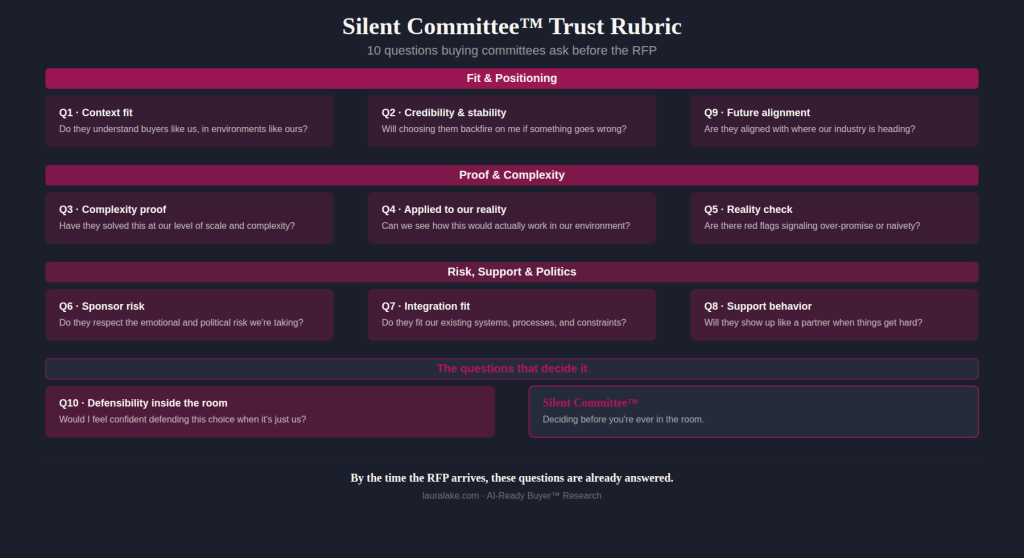
The 10 Trust Questions B2B Buying Committees Ask
These questions are already being asked in hallways, comment threads, and side chats you’ll never see. Each one maps to signals you can strengthen or gaps you’re leaving unaddressed.
1. Do they understand buyers like us, in environments like ours?
Stakeholders look for industry-relevant language and examples that reflect their reality. They don’t want to translate your story into their context. They want proof you understand their constraints, culture, and complexity well enough that choosing you won’t create surprises.
A global manufacturer quietly removed a well-known vendor from consideration after noticing every case study referenced software companies and startups. The offering was strong, but the Silent Committee couldn’t see a single example that matched a heavy-asset, unionized environment.
2. Do they feel stable enough that choosing them won’t backfire on me?
People ask whether you’ll still be around in three years. Whether other credible organizations trust you. Whether they’d be blamed for betting on a fragile or unproven partner if something goes wrong. These safety checks now sit inside structured vendor evaluation scorecards across most enterprise buying processes.
In one deal, a mid-market vendor was technically superior but lost to a slower, more expensive incumbent because the COO told the team: “If this fails with the big name, no one will blame us. If it fails with the newcomer, it’s on us.” The Silent Committee chose career safety over innovation.
3. Is there proof they’ve solved this at our level of complexity?
Generic success stories aren’t enough. Buyers want proof that looks like their world in scale, stakeholders, and stakes. They scan for evidence you’ve operated in messy, cross-functional environments with multiple teams, systems, and sensitivities—not just clean pilot projects. Verifiable customer proof and digital transparency are now primary filters in complex B2B buying.
A data platform showcased dozens of glowing testimonials, all from small teams. When a Fortune 100 prospect looked for references at similar scale, they found none. Internally, someone said, “This feels like a great tool for a department, not an enterprise.” The opportunity died quietly.
4. Can we see how this would work here, not just in theory?
Stakeholders look for signs you can map your approach into their specific systems, processes, and politics. They want clarity on how this works in their org chart and tech stack—what changes, who’s involved, where friction shows up—not just outcomes in other contexts.
Two vendors pitched an analytics rollout. One spoke in abstract benefits. The other showed a simple diagram with the prospect’s existing tools and where the new platform would sit. The second vendor’s diagram circulated in internal decks. By the time procurement stepped in, the choice was already made.
5. Are there red flags that signal over-promise or naivety?
Over-hyped language, sweeping claims, or lack of nuance read as risk, not confidence. When your story sounds more like a pitch than a grounded understanding of reality, the Silent Committee quietly tags you as a potential liability. Buyers burned by overpromising now filter vendors through substance over style in B2B buying experiences.
A change-management firm promised “friction-free transformation” on its homepage. To the leadership team of a heavily regulated organization with three unions and a compliance department that still used fax machines, this signaled the firm either didn’t understand internal resistance or preferred to ignore it. They never made the shortlist.
6. Do they respect the emotional and political risk we’re taking?
Every major purchase carries internal risk. Careers, reputations, and trust relationships are on the line for the people advocating for you. Stakeholders watch how you talk about change, adoption, and internal friction to decide whether you see them as people carrying risk or just “the buyer” in your funnel.
One vendor acknowledged in their materials that “there’s always a drop-off moment where logic flatlines and fear kicks in” and outlined how they support sponsors through that phase. In internal chats, the sponsor commented, “They actually get what this feels like.” That became a deciding factor.
7. Do they play well with our existing systems and constraints?
Most organizations aren’t buying a greenfield solution. They’re layering you into an already overloaded ecosystem. The Silent Committee looks for proof you can integrate—not just technically, but with existing teams, processes, and constraints—so choosing you doesn’t create hidden operational debt. Integration questions are part of what expands B2B buying committees to 6-10 stakeholders in complex deals.
A workflow tool lost a deal when engineering discovered it required significant custom scripting. The Silent Committee concluded, “This will just become another thing our already stretched team has to maintain,” and opted for a simpler vendor that fit more cleanly into current processes.
8. If this goes sideways, will they show up like a partner?
People read for how you talk about support, escalation, and accountability. They listen to references for stories about what happens when things are hard. They want to know whether you lean in when problems appear or disappear into legal language and ticket queues when the risk is highest for them.
During reference checks on two finalists, one customer said, “When we hit a snag, they brought in their senior team without us asking.” Another described months of blame-shifting. The Silent Committee’s notes on the second vendor were blunt: “Technically fine, but they’ll leave us alone when it matters.”
9. Do they feel aligned with where our industry is heading?
In fast-changing markets, stakeholders are wary of partners who are even slightly behind the curve. They look for signals that your perspective on AI, regulation, and market shifts matches where they believe the industry is going, so they’re not defending a partner who will look dated a year from now.
A financial services firm compared two vendors with similar capabilities. Only one was publishing credible, grounded perspectives on upcoming regulatory and AI shifts in their space. When the CFO asked, “Who’s going to help us stay ahead of this?” the answer was obvious.
10. Would I feel confident defending this choice when it’s just us?
Ultimately, someone has to stand in an internal meeting and say, “I think we should go with them.” The Silent Committee is testing whether your story, proof, and risk posture give them enough confidence—and enough language—to make that statement and withstand scrutiny from skeptics and leadership.
In a final alignment meeting, a VP pulled up one vendor’s one-pager that clearly summarized risks, mitigations, and proof points in executive language. “I can take this straight into the steering committee,” she said. The competitor had stronger feature slides but nothing that worked as a defense document. They lost.
How to Use This Vendor Selection Framework
Review your website, flagship case studies, thought leadership, and sales decks through each question. Where do you give a clear, credible answer? Where do you leave stakeholders to fill in the gaps themselves?
That exercise will reveal where you’re unintentionally asking buyers to take a leap of faith.
From there, prioritize closing the most critical gaps for your biggest deals or upcoming launches. Enablement can turn the rubric into a checklist for deal reviews. Product marketing can align narratives around the ten questions. Leadership can track trust signals as deliberately as they track pipeline.
When the Silent Committee meets—before you ever see the RFP—your brand should already feel like the least risky, most defensible answer to the questions they’re asking.
Frequently Asked Questions About B2B Vendor Trust
What is the Silent Committee in B2B buying?
The Silent Committee is the informal group of stakeholders who evaluate vendors before formal procurement begins. They meet in Slack threads, forwarded emails, and side conversations—forming opinions about vendor credibility, risk, and fit long before issuing an RFP or scheduling a demo. These B2B vendor trust questions get asked and answered in gaps your attribution model can’t see.
When do B2B buying committees start evaluating vendors?
B2B buying committees begin evaluating vendors weeks or months before formal engagement. In AI-first discovery environments, this happens even earlier—stakeholders use AI tools to compress your brand into summary sentences, compare you against competitors, and assess political risk before anyone from your sales team knows they’re being considered.
How can vendors answer trust questions before the RFP?
Vendors can answer Silent Committee trust questions by auditing their digital presence through the 10-question rubric. Review your website, case studies, thought leadership, and sales materials to identify where you provide clear proof of stability, relevant experience, and integration capability—and where you’re leaving stakeholders to fill gaps themselves. The goal is to make your brand feel like the least risky, most defensible choice before formal evaluation begins.
What’s the difference between awareness and trust in B2B vendor selection?
Awareness means buyers know you exist. Trust means they believe choosing you won’t backfire internally. In complex B2B deals, awareness is no longer the filter—buyers can find dozens of aware vendors through AI-assisted research. Trust is what determines who makes the shortlist. Trust answers the question: “Would I feel confident defending this choice when it’s just us in the room?”
Why do strong vendors get filtered out quietly?
Strong vendors get filtered out quietly because their proof doesn’t answer unspoken trust questions. They optimize for features, ROI, and differentiation—but fail to help internal champions make the political case. When a director asks “Are we sure this won’t blow up on us?” and your materials don’t address credibility, stability, or integration fit, you’re eliminated before objections surface.