
The B2B buying process changed three years ago. Most organizations are still designing GTM motions around the version that no longer exists.
For decades, vendor engagement was structurally necessary. Buyers couldn’t efficiently learn what solutions existed, evaluate options against each other, or assess implementation risk without talking to vendors. That dependency wasn’t a preference — it was a function of limited information access. Vendors controlled three essential buying functions: education, comparison, and risk validation.
That structural dependency ended when buyers built their own decision infrastructure to replace it.
The system buyers built is what I call the Silent Committee — the self-service infrastructure buyers now use to research, evaluate, and validate vendors independently, before any sales conversation begins. Not hidden stakeholders. Not a shadow buying committee. The system itself: AI agents synthesizing education, internal collaboration tools building consensus, peer validation platforms filtering risk.
By the time buyers reach out, the Silent Committee has already done most of the work. The shortlist is effectively set. The concerns are identified. The sales conversation confirms or contradicts conclusions already formed — it rarely changes them.
The Three Functions Buyers Replaced
The leverage vendors held in the old B2B buying process was a direct consequence of information scarcity. Buyers needed vendors for three things they couldn’t get anywhere else.
Education was vendor-controlled. Product information was scattered, gated, and jargon-heavy. Understanding what a solution actually did — how it worked, what it required, what it cost to implement — required sales conversations. Vendors owned the explanation.
Comparison required vendor participation. Marketing websites were brochures, not evaluation tools. Mapping features, pricing, and fit across multiple vendors required demos, discovery calls, and the structured comparisons that vendors provided.
Risk validation happened through vendor-arranged channels. Implementation risk, support quality, hidden costs — these were opaque without vendor access. Reference calls were the primary filtering mechanism, and vendors controlled who buyers talked to.
Each of these dependencies created leverage. When buyers needed vendors to function, vendors shaped perception, controlled the comparison frame, and managed the information environment that surrounded every decision.
That leverage dissolved when buyers built infrastructure that handles all three functions faster, with less friction, and with more perceived objectivity than vendor-led processes. This shift didn’t happen through procurement policy changes or buying committee restructuring. It happened through infrastructure replacement.
The Infrastructure Buyers Built
Three categories of tools — AI agents, internal collaboration tools, peer validation platforms — now perform the functions that vendor engagement used to provide.
AI agents replaced vendor-led education. A CFO types a question into ChatGPT or Perplexity: “What are the implementation risks of migrating to [Platform]?” Thirty seconds later, there’s a synthesized answer drawn from customer reviews, competitor analysis, third-party documentation, and Reddit threads. No discovery call. No vendor framing. No qualification process that filters what the buyer is allowed to know.
If the synthesis contradicts vendor positioning — and it frequently does — buyers trust the AI summary over the deck. The vendor’s carefully constructed narrative arrives after the education has already happened.
Internal collaboration tools replaced formal comparison processes. A product manager drops a question into Slack: “Has anyone worked with [Vendor]?” Within hours, colleagues share unfiltered experiences that no reference call would surface. The alignment that used to happen across formal demos and comparison matrices now happens in asynchronous threads — before the vendor knows an evaluation is occurring.
Peer validation platforms replaced vendor-arranged risk assessment. G2, TrustRadius, Reddit, LinkedIn — buyers scroll through hundreds of reviews filtered by company size and use case, reading unedited accounts of onboarding timelines, support responsiveness, and hidden costs. The risk assessment that once required vendor-arranged reference conversations now happens at scale, independently, at 10pm on a Tuesday.
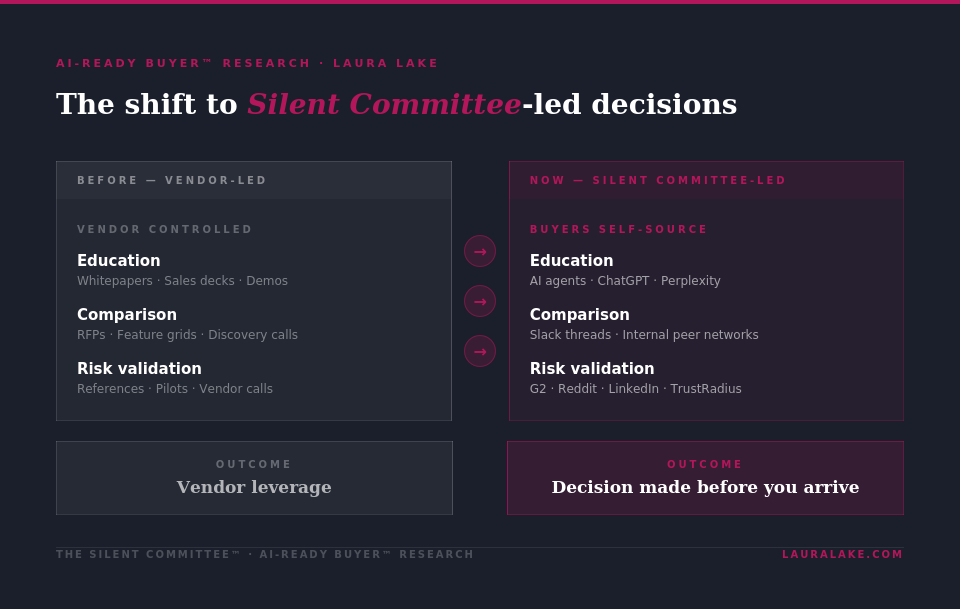
Together, these three infrastructure layers form the Silent Committee. It operates continuously. It doesn’t require vendor engagement to function. And it produces conclusions before sales engagement begins. This infrastructure shift explains why traditional buyer journeys no longer describe how decisions form and why buying committees now operate as systems rather than groups of people.
Here’s what typically happens when a senior leader — usually a CRO who just lost a deal they didn’t see coming — realizes their buyers are somewhere they can’t measure.
They send the question to marketing. Marketing routes it to demand gen. Demand gen runs a campaign report showing strong MQL volume and healthy click-through rates. The data looks fine. The CRO isn’t satisfied but can’t articulate exactly why. The question bounces. Someone schedules a meeting to talk about the website. Someone else suggests a content audit. The conversation eventually dissolves into a discussion about social media cadence.
No one in that room had visibility across the full surface area the Silent Committee was consulting. Marketing owned the website. PR owned earned media. Social owned LinkedIn. Nobody owned Reddit. And nobody owned the synthesis layer — the point where AI assembled all of it simultaneously into the first impression that shaped whether a buyer put the company on the shortlist at all.
(I’ve sat in versions of this meeting more times than I’d like to count. The tell is always the same: everyone in the room is confident about their piece. Nobody can account for the whole.)
The result isn’t a failure of individual teams. It’s a structural condition — what I call the Ownership Gap — in which signal architecture is incoherent by default, because no single function has the mandate or the visibility to diagnose it as a system.
The Three Costs That Accumulate Before First Contact
By the time a buyer schedules a call, the Silent Committee has typically settled three things — and the cost of each is already fixed.
The credibility verdict. Does this vendor show up consistently and coherently across the surfaces buyers actually consult? If the website says one thing, the G2 reviews surface another, and the LinkedIn presence contradicts both, the credibility signal is fragmented. Fragmented signals read as low-trust — not because the vendor is untrustworthy, but because the signal architecture can’t support a confident assessment. Signal architecture is the structural diagnosis — not a visibility problem, not a messaging problem, but a question of whether the pieces connect into something coherent enough for a non-human reader to trust. The verdict is reached before the first email is sent.
What the Silent Committee is reading when it reaches that verdict is your Trust Layer™ — the accumulated credibility infrastructure across your reviews, your content, your peer mentions, and your consistency across every surface buyers reach before any seller interaction.
The risk register. What are the real implementation challenges, the support gaps, the features that don’t work as advertised? The Silent Committee surfaces these without asking — through Reddit threads, G2 reviews filtered by use case, peer Slack conversations. The concerns that vendor-led processes are designed to manage appear in the research phase instead. By the time a buyer enters a demo, they’ve already catalogued the risks. The demo either addresses them or doesn’t.
The competitive default. Which vendor feels safest? The comparison isn’t conducted through vendor materials — it’s conducted through the same peer networks and AI synthesis that handle education. If a competitor has stronger signal architecture, more consistent peer validation, or more coherent AI summaries, the comparison has already happened against those signals. The vendor who shows up late to a discovery call isn’t starting from neutral. They’re starting from behind.
The sales conversation that follows inherits these three settled questions. A demo that contradicts what the Silent Committee established isn’t persuasive — it’s suspect. The evidence layer already exists. The vendor’s pitch is measured against it.
The Sales Function This Creates
When the Silent Committee has already resolved credibility, risk, and competitive positioning before first contact, the sales function operates in a fundamentally different role than the one most GTM organizations are designed for.
Sales doesn’t shape the initial decision frame — it inherits it. The perception that exists when a buyer schedules a call was formed through the Silent Committee, not through vendor engagement. The discovery call doesn’t discover — it validates what the buyer has already concluded.
This isn’t a failure of sales execution. It’s a structural feature of how AI-mediated buying works. The leverage point moved upstream. Organizations that recognize this design for it. Organizations that don’t continue investing in sales processes that operate after most of the decision has already been made.
The CMO who lost Q4 revenue to this dynamic didn’t lose it in Q4. They lost it in the six weeks before the pipeline showed up — when buyers were researching, comparing, and filtering through a system that the company’s GTM motion wasn’t designed to see. You’re not in the consideration set because you were never in the place where the decision formed.
FAQs About the Silent Committee in the B2B Buying Process
What is the Silent Committee?
The Silent Committee is the self-service infrastructure buyers now use to research, evaluate, and validate vendors before any sales conversation begins. Not a group of hidden stakeholders — the system itself: AI agents synthesizing education, internal collaboration tools building consensus, peer validation platforms filtering risk. This infrastructure operates continuously and produces conclusions before sales engagement begins.
What three functions did buyers replace — and with what?
Vendors used to control education, comparison, and risk validation. Buyers replaced all three. AI agents (ChatGPT, Perplexity, Claude) replaced vendor-led education by synthesizing information instantly from multiple sources. Internal collaboration tools (Slack, Teams) replaced formal comparison processes through peer-to-peer consensus in asynchronous threads. Peer validation platforms (G2, Reddit, TrustRadius, LinkedIn) replaced vendor-arranged reference calls by surfacing unfiltered customer experience at scale.
What does the Silent Committee determine before first contact?
Three things — and the cost of each is already fixed before a buyer schedules a call. The credibility verdict: whether the vendor shows up consistently across the surfaces buyers actually consult. The risk register: real implementation challenges, support gaps, and features that don’t work as advertised, surfaced through peer reviews and community threads. The competitive default: which vendor feels safest, determined through the same AI synthesis and peer networks that handle education.
Why aren’t B2B buyers responding to outreach?
Because the evaluation is largely over by the time outreach arrives. The Silent Committee has already filtered vendors, identified concerns, and determined which options feel safest. Buyers contact vendors to confirm conclusions already reached — not to be educated or persuaded. If a vendor’s signal architecture didn’t register during independent research, outreach arrives after the decision is effectively made.
What is the Ownership Gap — and why does it matter?
The Ownership Gap is the structural condition most organizations are in: marketing owns the website, PR owns earned media, social owns LinkedIn, nobody owns Reddit, and nobody owns the synthesis layer where AI assembles all of it into the first impression that shapes whether a buyer puts the company on the shortlist. It’s not a failure of individual teams — it’s a structural feature of how organizations are built, and a structural vulnerability in AI-mediated buying environments.